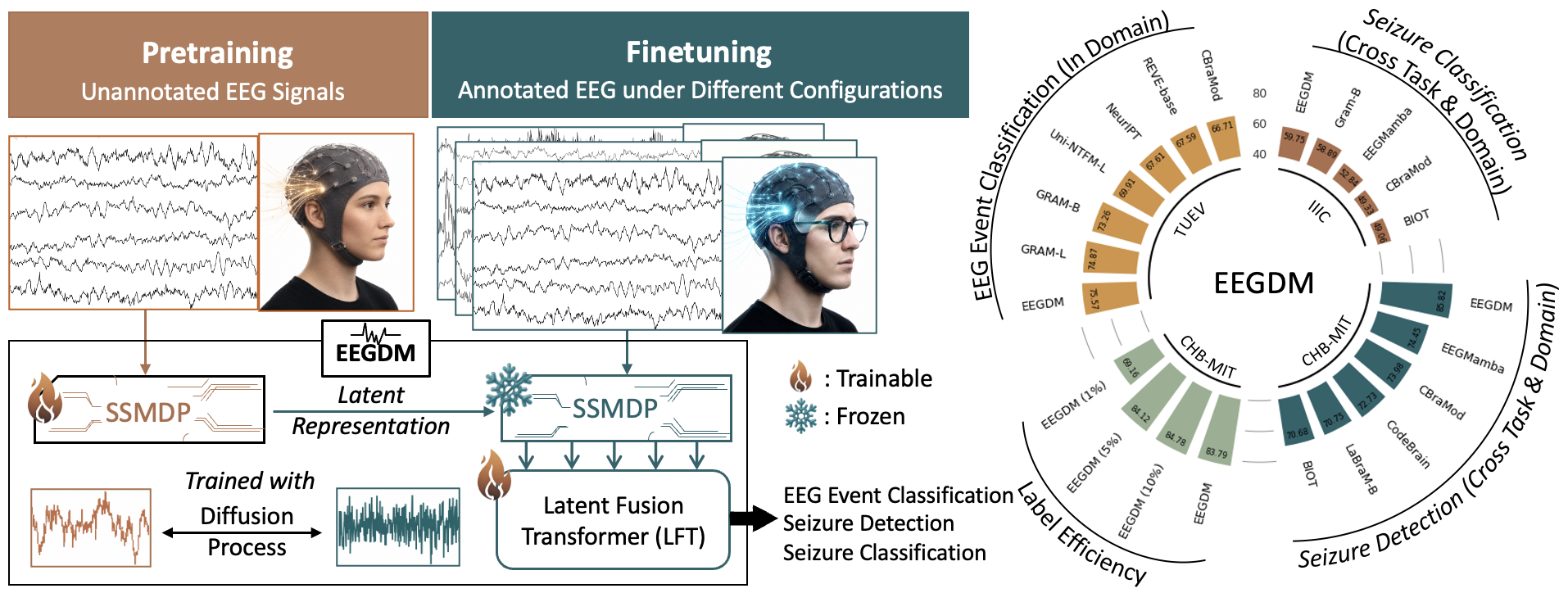
This work moves away from the typical masked-reconstruction pretraining employed in EEG foundation models (FMs), thereby avoiding the introduction of discontinuities—such as patching or tokenization—into fundamentally continuous EEG signals. Instead, a score-matching objective from diffusion models is utilized for pretraining, and the latent activities of the pretrained diffusion backbone are leveraged for EEG representation.
Two unique challenges were encountered and resolved:
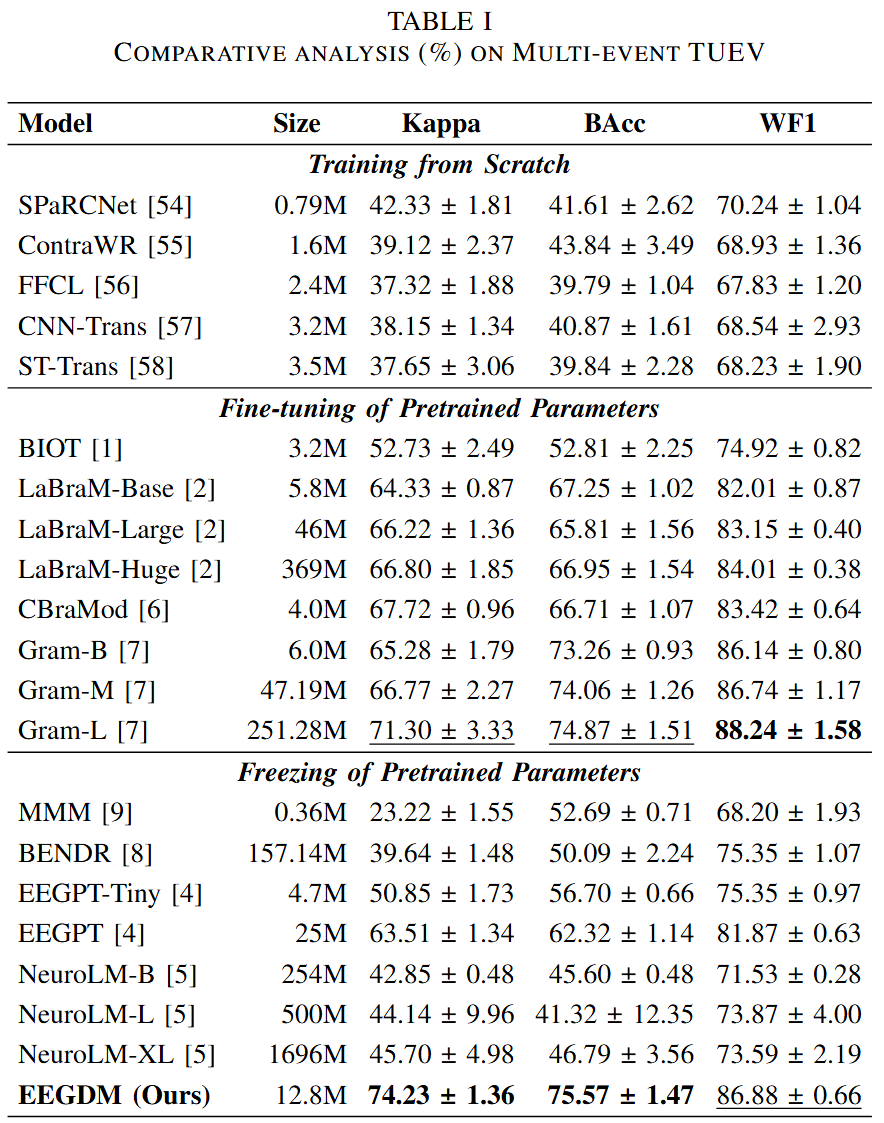
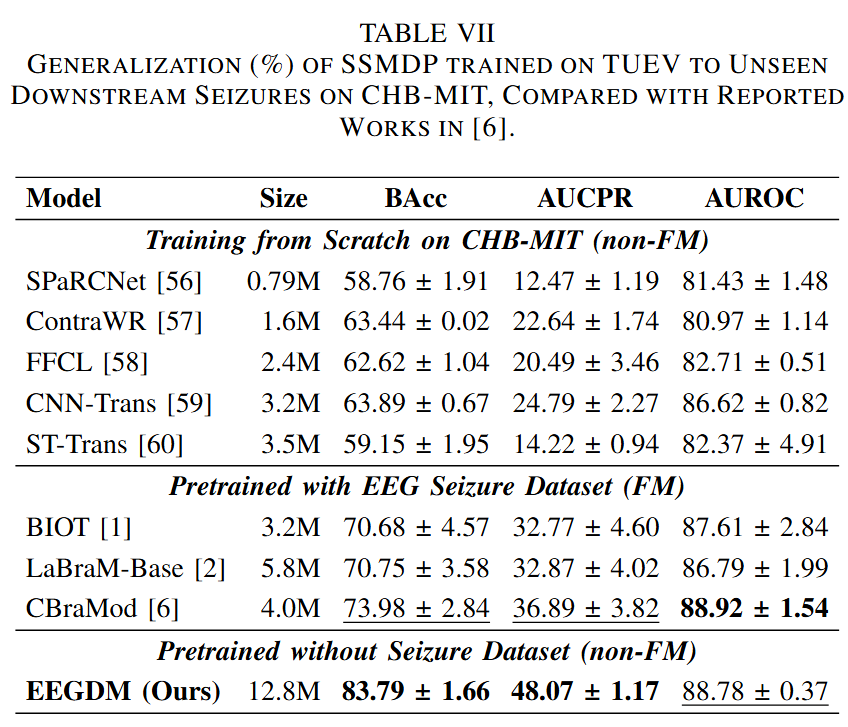
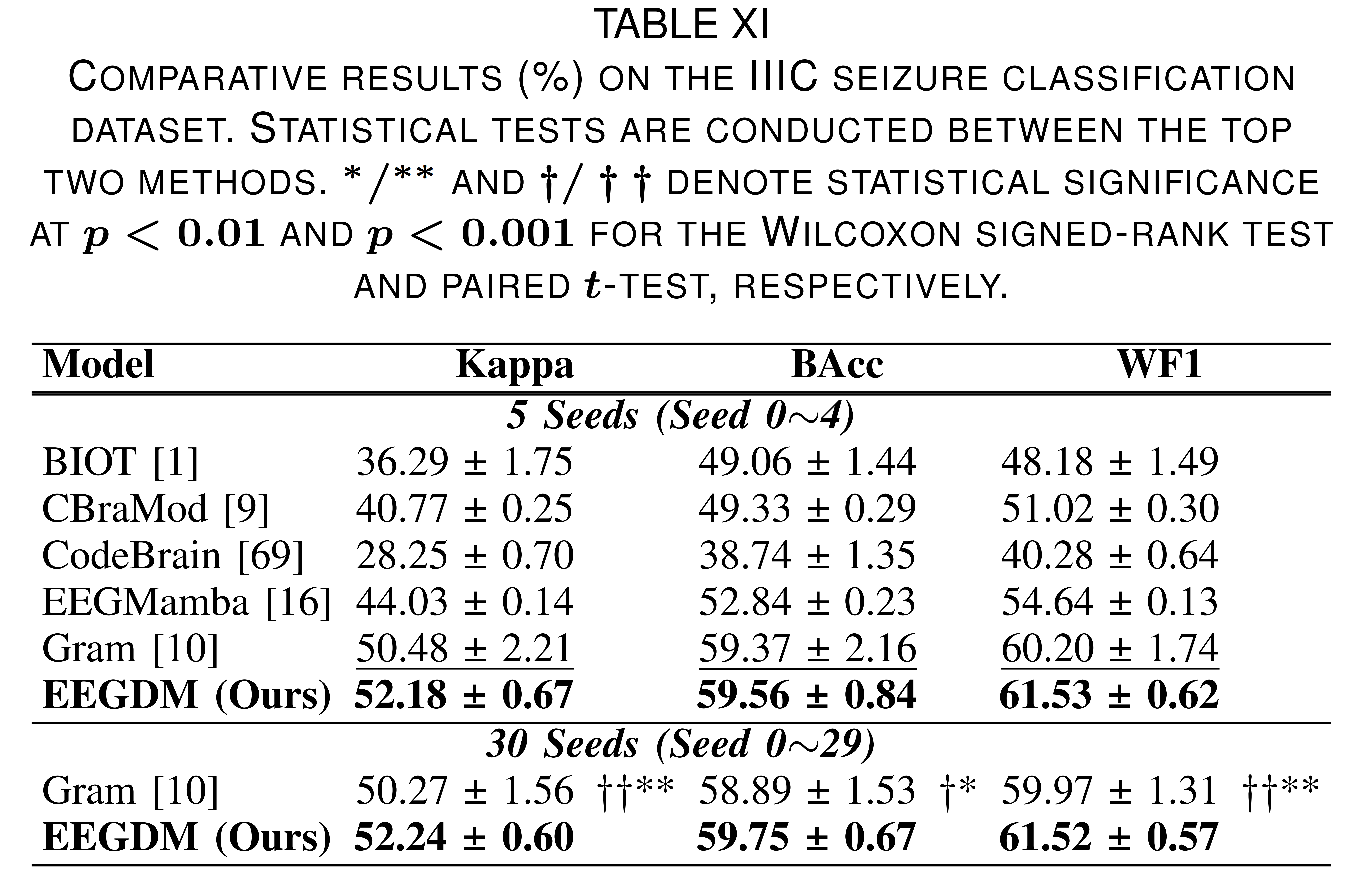
As a result, our proposed method demonstrates state-of-the-art performance alongside strong cross-domain and cross-task generalization in epilepsy-related tasks. It outperforms existing foundation models while using a smaller model size and only a single pretraining dataset.
Benchmarking on a single Nvidia RTX 4090 demonstrates the high efficiency of EEGDM:
In contrast to FMs, our approach does not require high-grade hardware or tremendous training data, while still achieving high performance and strong generalization.
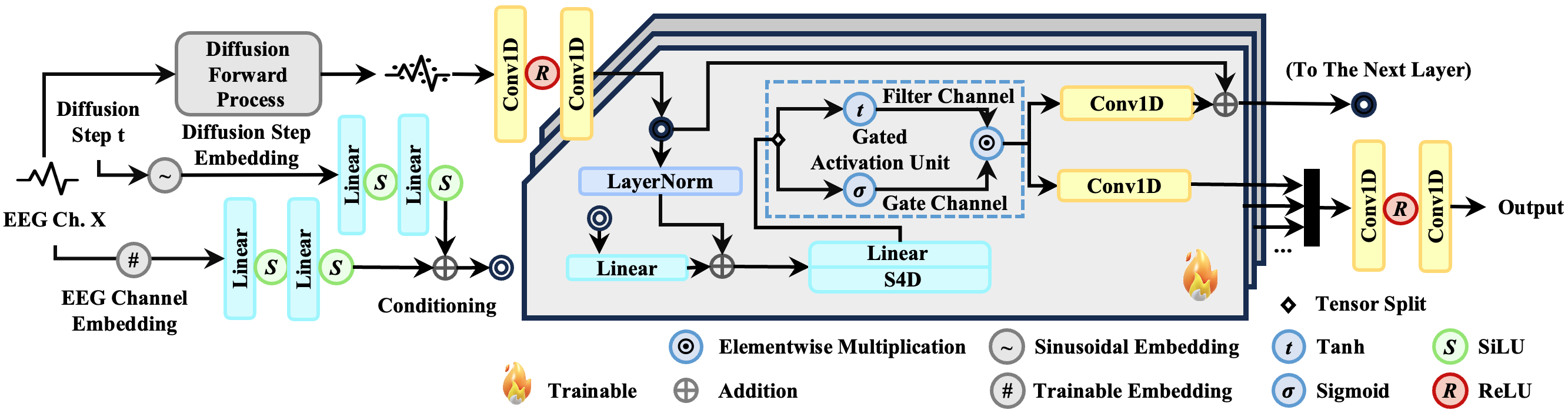
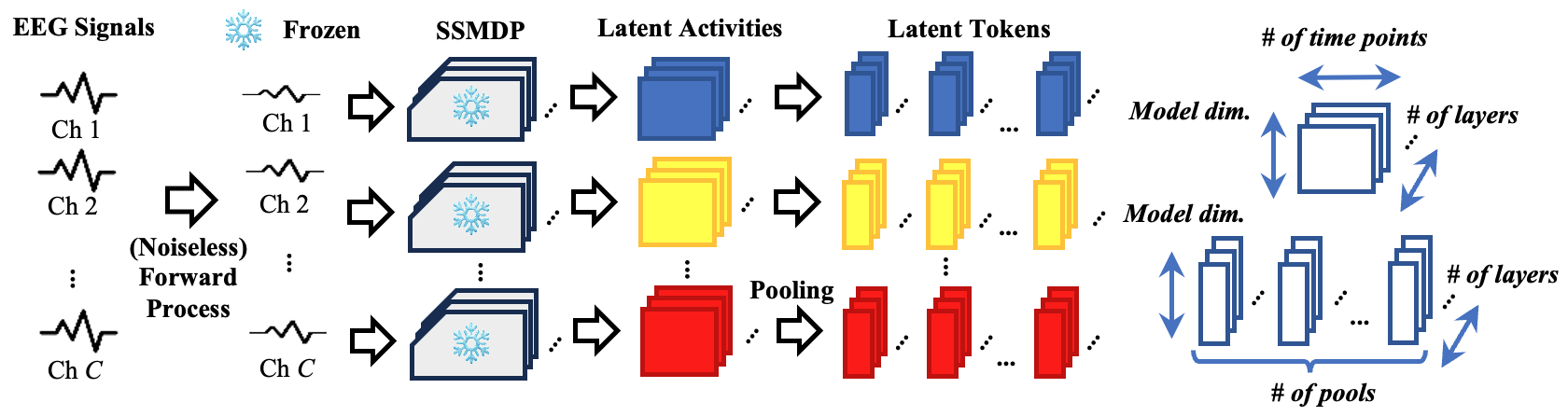
Unlike autoencoders, which are optimized to output representations, our diffusion-based pretraining encourages representations to spontaneously emerge across the entire backbone. Consequently, this requires special care to collect and condense these scattered representations.
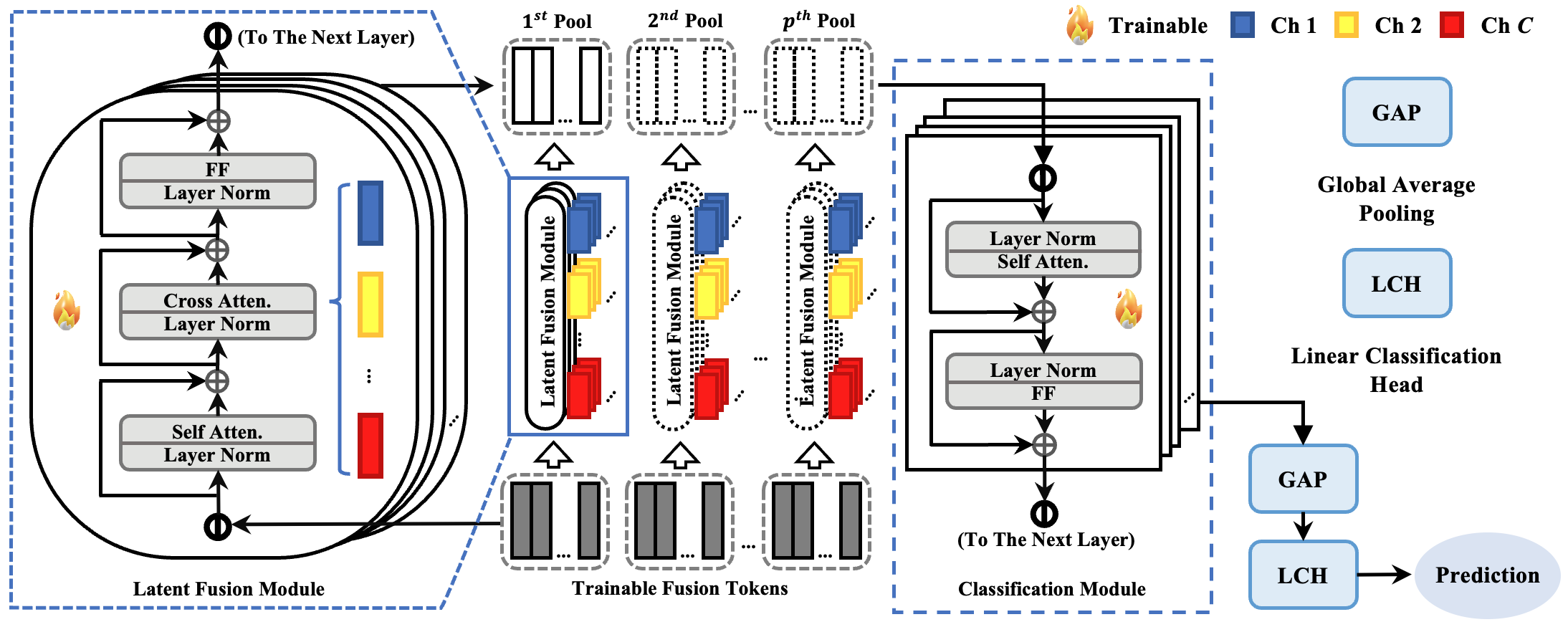
LFT is a transformer-based architecture designed to take the learned latent representations from the SSMDP and fuse them for classification tasks. Because the latent representations are high-dimensional, they are first pooled to reduce computational complexity. The LFT has a "latent fusion module" that uses a decoder-only transformer to aggregate the information from different EEG channels and layers. This module uses "fusion tokens" to create a context-aware feature for each time window of the signal. The "classification module" then takes these fused representations and processes them through an encoder-only transformer, finally using a linear classification head to make predictions. This fine-tuning phase is trained in a supervised manner on a specific task.